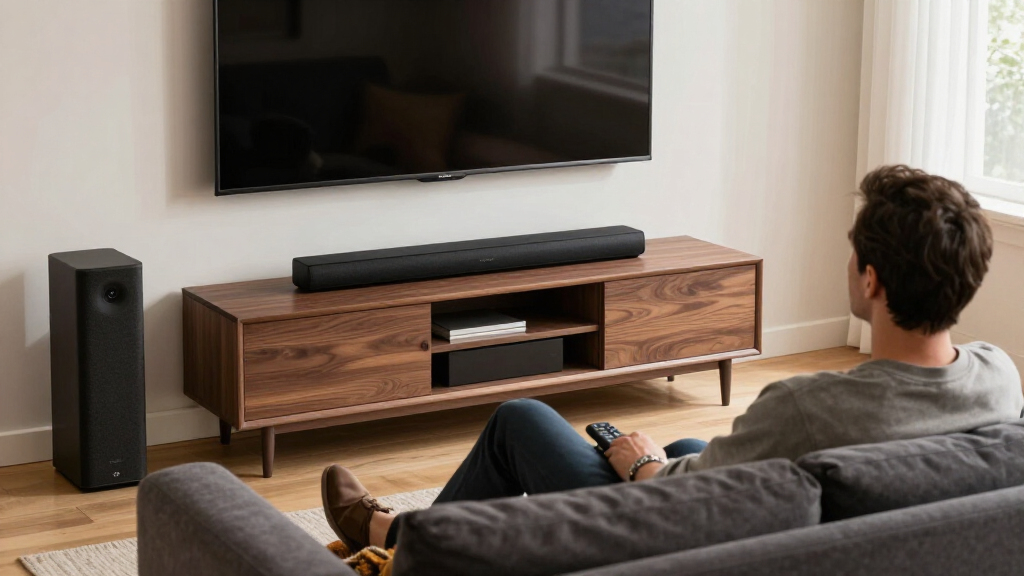
Among soundbars with wireless subwoofers, I’d put the Samsung HW-Q800F first for its 5.1.2-channel design and balance of immersive sound with a simpler setup than a full rear-speaker system. The JBL Bar 500MK2 is a strong alternative for buyers focused on Dolby Atmos, while the LG S60T adds a center channel that can help dialogue stand out. The main tradeoff is between a compact 2.1 setup that is easy to place and larger systems with more channels, speakers, and room-filling effects. Wireless subwoofers also need a suitable spot and power outlet, so placement still matters. Read on for the full breakdown and recommendations by room, setup, and listening priorities.

Get business pricing on your home office setup
- Business-only prices and quantity discounts
- Tax-exempt purchasing
- Multiple users, one account, clear invoices
Complete the kit


Key Takeaways
- The Samsung HW-Q800F is my best overall pick for combining a 5.1.2-channel layout with a wireless subwoofer without requiring separate rear speakers.
- The JBL Bar 500MK2 and Samsung HW-Q990H serve different surround goals: the Bar 500MK2 keeps the system simpler, while the Q990H adds rear speakers for a more complete surround setup.
- Channel count changes the experience more than the wireless subwoofer alone. Basic 2.1 models focus on clearer TV sound and bass, while systems with center, height, or rear channels aim for dialogue separation and immersion.
- Dialogue-focused shoppers have several step-up choices. The LG S60T and Samsung HW-B630F add a center channel compared with simpler 2.1 options such as the Hisense HS2100 and TCL S55H.
- Wireless does not mean placement-free. Every subwoofer still needs power and a location where its bass works well in the room, so compact room layout can favor a simpler bar.


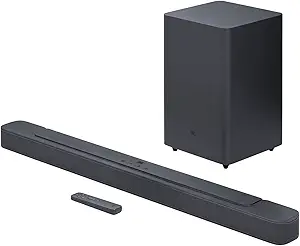


| soundbars with wireless subwoofer | Channels | Subwoofer |
|---|---|---|
| Samsung HW-B550F 2.1-Channel S | 2.1 | Wireless, included |
| LG S60T 3.1-Channel Soundbar w | 3.1 | Wireless |
| JBL Bar 700MK2 7.1-Channel Sou | 7.1 | 10-inch, wireless |
| Samsung HW-Q800F 5.1.2ch Q-Ser | 5.1.2 | Wireless; 6.5-inch active driver with 8-inch passive radiator |
| ULTIMEA Poseidon M60 5.1-Chann | 5.1 | 5.25-inch wired wooden subwoofer |
| JBL Bar 500MK2 5.1-Channel Sou | 5.1 | 10-inch wireless |
| LG S40TR 4.1-Channel Home Thea | 4.1 | — |
| Polk Audio Signa S2 Ultra-Slim | — | Wireless, included |
| ULTIMEA Skywave X40 5.1.2-Chan | 5.1.2 | — |
| Hisense HS2100 2.1ch Soundbar | 2.1 | — |
| JBL Bar 2.1 Deep Bass | — | Wireless, 6.5" |
| Ultimea Sound Bar with Wireles | — | Wireless, 6.5 L tuned cabinet |
| Samsung B-Series HW-B630F 3.1- | — | Wireless |
| TCL S55H 2.1 Soundbar with Wir | — | — |
| Samsung HW-Q990H Q-Series Soun | 11.1.4 | — |
More Details on Our Top Picks
Samsung HW-B550F 2.1-Channel Soundbar with Wireless Subwoofer
The Samsung HW-B550F pairs a straightforward 2.1-channel bar with an included wireless subwoofer, giving buyers a separate bass unit without the extra speakers or wiring of a larger surround kit. DTS Virtual:X aims to broaden the sound from the front of the room, while Adaptive Sound and Voice Enhance Mode address changing content and dialogue. Compared with the LG S60T, it gives up a dedicated center channel, so the LG is the better fit if speech clarity is the priority. The Samsung’s appeal is a simpler, more compact starting point, with Bass Boost for listeners who want more low-end emphasis. Its virtual surround cannot match physical rear speakers, and expanding the system requires buying optional wireless rears separately.
Pros:- Wireless subwoofer adds bass without a cable running from the bar
- DTS Virtual:X broadens the presentation without rear speakers
- Adaptive Sound adjusts audio for different content
- Voice Enhance Mode helps dialogue stand out
Cons:- No dedicated center channel, unlike the LG S60T
- Wireless rear speakers are optional and sold separately
- Virtual surround cannot reproduce the placement of physical rear speakers
Best for: Viewers who want a simple TV audio upgrade with wireless bass and no rear-speaker setup
Not ideal for: Dialogue-focused viewers who want a dedicated center channel or buyers seeking included physical surround speakers
- Model:HW-B550F
- Channels:2.1
- Audio technology:DTS Virtual:X
- Subwoofer:Wireless, included
- Sound features:Adaptive Sound, Voice Enhance Mode, Bass Boost
- Rear speakers:Optional wireless expansion
Our verdict“Choose the HW-B550F for a basic, easy-to-place soundbar and wireless subwoofer; choose the LG S60T if clearer dialogue from a center channel matters more.”
LG S60T 3.1-Channel Soundbar with Wireless Subwoofer, Dolby Audio, and AI Sound Pro
The LG S60T earns its place with a dedicated center channel alongside its wireless subwoofer. That extra channel gives dialogue a defined place in the front soundstage, which suits TV dramas and news better than the simpler 2.1-channel Samsung HW-B550F. Dolby Audio and AI Sound Pro add format support and content-based adjustment, while compatible LG televisions can use WOW Orchestra and the WOW Interface for integrated sound and control. Those TV features are limited to select LG models, so they should not be the main reason to choose it without checking compatibility. At 33.5 inches wide and 18.2 pounds, it is a substantial bar; it also lacks the detachable surrounds and larger-scale setup of the JBL Bar 700MK2. The S60T prioritizes front-stage intelligibility over room-filling expansion.
Pros:- Dedicated center channel gives dialogue a distinct position
- Wireless subwoofer adds bass without a direct cable to the bar
- AI Sound Pro adjusts audio to different content
- WOW Orchestra and WOW Interface integrate with select LG TVs
Cons:- WOW features work only with compatible LG TV models
- The 33.5-inch bar and 18.2-pound weight may not suit smaller setups
- Does not include detachable surround speakers like the JBL Bar 700MK2
Best for: LG TV owners and dialogue-focused viewers who want a center channel with a wireless subwoofer
Not ideal for: Buyers seeking detachable rear surrounds, a compact lightweight bar, or LG-specific integration without a compatible TV
- Channels:3.1
- Audio technology:Dolby Audio
- Subwoofer:Wireless
- Sound processing:AI Sound Pro
- Dimensions:3.5 × 33.5 × 2.5 inches
- Weight:18.2 pounds
- USB:1 USB 2.0 port
- Bluetooth range:10 meters
Our verdict“Pick the S60T if clear dialogue and a compatible LG TV matter more than detachable surrounds or a particularly compact system.”
JBL Bar 700MK2 7.1-Channel Soundbar with Wireless Subwoofer, Dolby Atmos, Black
For buyers who want surround speakers without committing to permanent rear wiring, the JBL Bar 700MK2 has a distinctive advantage: its wireless surround speakers detach from the bar for placement around the room. Together with a 10-inch wireless subwoofer, that makes this a more expansive system than the front-focused LG S60T or the 2.1-channel Samsung HW-B550F. Dolby Atmos, DTS Virtual:X, and MultiBeam 3.0 support a broader presentation, while PureVoice 2.0 is designed to keep dialogue clear. Spotify Connect, AirPlay, and Google Cast add several ways to stream music. This feature-rich 7.1 setup will suit movie watchers who want flexible surround placement, but it brings more pieces to position than a basic bar-and-subwoofer pairing. The supplied details do not specify dimensions or total system weight, so buyers should check fit before choosing it for a tight console.
Pros:- Detachable wireless surround speakers allow flexible placement
- Includes a 10-inch wireless subwoofer
- Supports Dolby Atmos and DTS Virtual:X
- Spotify Connect, AirPlay, and Google Cast support music streaming
Cons:- More components to place than a basic bar-and-subwoofer system
- Room fit may be harder to judge because dimensions and weight are not provided
- Its 7.1-channel feature set may be unnecessary for buyers seeking a simple TV upgrade
Best for: Movie watchers who want detachable wireless surround speakers and a large wireless subwoofer
Not ideal for: Buyers who need a minimal two-piece setup or have limited room for multiple speakers
- Channels:7.1
- Maximum system power:780 W
- Subwoofer:10-inch, wireless
- Surround speakers:Detachable, wireless
- Audio formats:Dolby Atmos, DTS Virtual:X
- Sound technology:MultiBeam 3.0, PureVoice 2.0
- Streaming:Spotify Connect, AirPlay, Google Cast
- Color:Black
Our verdict“Choose the Bar 700MK2 for flexible wireless surround and substantial bass, provided you have room for its detachable speakers.”
Samsung HW-Q800F 5.1.2ch Q-Series Soundbar with Wireless Subwoofer (2025 Model)
The Samsung HW-Q800F is the pick for buyers who want height and side effects from the soundbar itself. Its 5.1.2-channel layout includes physical up-firing and side-firing speakers, giving Dolby Atmos and DTS:X more direct support than the virtual processing on the Samsung HW-B550F. The included wireless subwoofer combines a 6.5-inch active driver with an 8-inch passive radiator, while SpaceFit Sound Pro adapts the system to the room. Built-in Alexa, AirPlay 2, Google Cast, and Wi-Fi 6 broaden its smart and streaming options; Game Mode Pro also targets directional console audio. Compared with the JBL Bar 700MK2, it keeps surround hardware in the bar rather than using detachable rear speakers. Q-Symphony is useful only with a compatible Samsung TV, and this feature-rich system is more than a basic 2.1-channel setup requires.
Pros:- Physical up-firing and side-firing speakers support a 5.1.2-channel presentation
- Wireless subwoofer includes a 6.5-inch active driver and 8-inch passive radiator
- SpaceFit Sound Pro calibrates audio to the room
- Built-in Alexa, AirPlay 2, Google Cast, and Wi-Fi 6 offer flexible control and streaming
Cons:- Q-Symphony requires a compatible Samsung TV
- Unlike the JBL Bar 700MK2, it does not include detachable wireless rear speakers
- Its channel configuration and smart features may be more setup than casual TV viewing needs
Best for: Samsung TV owners and home theater viewers who want physical height channels, room calibration, and smart streaming
Not ideal for: Buyers who want detachable rear speakers or a straightforward, minimal soundbar setup
- Model:HW-Q800F
- Channels:5.1.2
- Surround formats:Wireless Dolby Atmos, DTS:X
- Subwoofer:Wireless; 6.5-inch active driver with 8-inch passive radiator
- Room and TV features:SpaceFit Sound Pro, Q-Symphony
- Dialogue enhancement:Active Voice Amplifier Pro
- Voice assistant:Built-in Alexa
- Connectivity:HDMI eARC, Wi-Fi 6, Bluetooth 5.2, AirPlay 2, Google Cast
Our verdict“Choose the HW-Q800F for built-in height effects and room calibration, especially if you own a compatible Samsung TV.”
ULTIMEA Poseidon M60 5.1-Channel Dolby Atmos Soundbar System
The ULTIMEA Poseidon M60 offers a 5.1-channel setup and a wide range of app controls, including a 10-band EQ, 121 sound presets, and adjustable surround levels. That makes it a flexible choice for listeners who like shaping audio to their room and content. It supports Dolby Atmos over HDMI eARC and provides voice enhancement, but its 5.25-inch wooden subwoofer is wired. That distinction matters in a roundup centered on wireless subwoofers: unlike the Samsung HW-Q800F or LG S60T, the M60 requires a cable from the subwoofer to the system. It also has no included rear speakers, so its 5.1-channel description does not mean you can place physical surrounds behind the sofa. Buyers get extensive tuning controls and flexible tabletop or wall mounting, with a less convenient subwoofer placement tradeoff.
Pros:- Dolby Atmos support over HDMI eARC
- App provides a 10-band EQ, 121 presets, and adjustable surround levels
- Voice enhancement is designed to improve dialogue clarity
- Can be placed on a tabletop or mounted on a wall
Cons:- Subwoofer is wired, unlike the wireless units in the Samsung HW-Q800F and LG S60T
- No rear speakers are included
- The wired subwoofer limits placement flexibility
Best for: Hands-on listeners who want app-based EQ and presets and can place a wired subwoofer near a power connection
Not ideal for: Buyers who specifically need a wireless subwoofer or included physical rear speakers
- Channels:5.1
- Audio format:Dolby Atmos
- Peak power:300 W
- Subwoofer:5.25-inch wired wooden subwoofer
- Frequency response:45 Hz–18 kHz
- Connectivity:HDMI eARC, Bluetooth 5.4
- Equalizer:10-band graphic EQ; 121 sound presets
- Dimensions:31.5 × 3.54 × 2.76 inches
Our verdict“Consider the Poseidon M60 for its detailed app tuning only if a wired subwoofer fits your room and your priorities.”
JBL Bar 500MK2 5.1-Channel Soundbar System with Dolby Atmos and Wireless Subwoofer
Where most soundbars in this roundup settle for virtualized surround, the JBL Bar 500MK2 goes for the real thing: a true 5.1-channel layout with a 10-inch wireless subwoofer that outclasses the smaller woofers bundled with the Polk Signa S2 or Hisense HS2100. That driver size matters — it’s the difference between bass you hear and bass you feel during action scenes. Dolby Atmos with MultiBeam 3.0 bounces height cues around the room, and PureVoice 2.0 keeps dialogue intelligible even when explosions take over. Room calibration tunes output to your space, something the ULTIMEA Skywave X40 leaves to the user. The tradeoff: streaming features like AirPlay and Google Cast demand compatible devices and a network setup, so buyers wanting a plug-and-play bar may find the extras wasted. Compared with its bigger sibling, the JBL Bar 700MK2, this model skips detachable rear speakers but costs and occupies less.
Pros:- Genuine 10-inch wireless subwoofer delivers bass depth most bundled subs can’t match
- Dolby Atmos and MultiBeam 3.0 create real height and surround effects
- PureVoice 2.0 keeps dialogue clear during loud scenes
- Automatic room calibration plus broad streaming support (AirPlay, Google Cast, Spotify Connect)
- 4K Dolby Vision passthrough keeps picture quality intact
Cons:- Streaming and voice assistant features require compatible devices and network setup
- At this price, some buyers will expect rear speakers like the LG S40TR includes
Best for: Home theater enthusiasts who want genuine Atmos height effects and deep, room-shaking bass without buying rear speakers separately
Not ideal for: Buyers without smart home devices or streaming subscriptions — much of the feature set stays locked away
- Channels:5.1
- Maximum system output:750W
- Subwoofer:10-inch wireless
- Audio technologies:Dolby Atmos, MultiBeam 3.0, PureVoice 2.0, SmartDetails
- Connectivity:HDMI eARC, HDMI input, AirPlay, Google Cast, Spotify Connect, Tidal Connect, Roon Ready
- Video passthrough:4K Dolby Vision
- App:JBL ONE
Our verdict“If Atmos immersion and serious low-end are the priority and rear speakers aren’t required, this is the premium pick that justifies its cost.”
LG S40TR 4.1-Channel Home Theater Soundbar with Rear Surround Speakers and Wireless Subwoofer
Most options here — the Hisense HS2100, the Polk Signa S2 — simulate surround sound. The LG S40TR actually delivers it, bundling rear surround speakers alongside the wireless subwoofer for a genuine 4.1-channel field. That physical separation is what makes sounds pan behind you during movies, something DTS Virtual:X processing can only approximate. Clear Voice Plus handles dialogue, while the Smart Up-Mixer spreads stereo content across all channels so music doesn’t feel wasted on the extra speakers. If you own a compatible LG TV, WOW Interface and WOW Orchestra sync the bar and TV speakers into one system — a convenience Samsung and JBL models can’t replicate on LG displays. The catch is wiring: the rear speakers still need a physical connection to each other and wall power, so this isn’t a fully wireless solution like the ULTIMEA Skywave X40’s dual 5GHz setup.
Pros:- Rear surround speakers included for genuine 4.1-channel immersion
- Dolby Audio and DTS Digital support for movies and music
- Clear Voice Plus lifts dialogue out of busy soundtracks
- Deep LG TV integration via WOW Interface and WOW Orchestra
Cons:- Rear speakers need a wired link between them plus access to power
- TV integration features only work with compatible LG models
- No Dolby Atmos support, unlike the JBL Bar 500MK2
Best for: Movie watchers who want physical rear surround speakers in the box rather than paying for a separate kit later
Not ideal for: Renters or anyone unwilling to run cables — the rear speakers require wiring and power outlets despite the wireless subwoofer
- Brand:LG
- Model:S40TR
- Channels:4.1
- Audio technologies:Dolby Audio, DTS Digital, AI Sound Pro, Clear Voice Plus, Smart Up-Mixer
- Included components:Soundbar, wireless subwoofer, rear surround speakers
- TV integration:WOW Interface, WOW Orchestra
- Soundbar dimensions:28.4″ x 2.5″ x 3.4″
- Subwoofer dimensions:6.7″ x 12.6″ x 9.9″
Our verdict“This is the pick for buyers who refuse to accept simulated surround and want actual speakers behind them without the premium price of an Atmos flagship.”
Polk Audio Signa S2 Ultra-Slim Soundbar with Wireless Subwoofer
At just over two inches tall, the Polk Signa S2 solves a problem none of the bulkier options here address: it fits under a TV without blocking the screen or the remote sensor. Compared with the Hisense HS2100, it takes the same simple 2.1-plus-subwoofer formula but adds VoiceAdjust technology, which gives dialogue its own dedicated volume control — a genuine help for households that argue about turning the TV up. Five full-range drivers push a wider soundstage than a typical two-driver bar, and the wireless subwoofer handles the low end. Connections are refreshingly flexible: HDMI ARC, optical, AUX, and Bluetooth cover nearly every TV and device made in the last decade. There’s no Atmos, no surround trickery, and no app ecosystem like the JBL ONE platform offers — this is a straightforward upgrade over TV speakers, and it doesn’t pretend to be more.
Pros:- Ultra-slim 2-inch height fits in front of most TVs without blocking the screen
- VoiceAdjust gives independent control over dialogue volume
- Wireless subwoofer included at a budget-friendly tier
- Four connection options: HDMI ARC, optical, AUX, and Bluetooth
Cons:- No Dolby Atmos or any surround-sound format beyond Dolby Digital decoding
- Subwoofer output is modest next to the 10-inch driver in the JBL Bar 500MK2
Best for: Owners of wall-mounted TVs or small stands who need a low-profile bar that won’t block the picture
Not ideal for: Buyers chasing Atmos height effects or surround processing — this is a stereo-plus-sub setup with no spatial audio ambitions
- Drivers:5 full-range drivers
- Subwoofer:Wireless, included
- Height:Just over 2 inches
- Audio technologies:VoiceAdjust, Dolby Digital decoding
- Connections:HDMI ARC, optical, AUX, Bluetooth
Our verdict“The right choice when clearance is tight and the goal is clearer TV audio with real bass — not a home theater overhaul.”
ULTIMEA Skywave X40 5.1.2-Channel Soundbar System
The ULTIMEA Skywave X40 makes a bold spec argument: 5.1.2 channels with height effects, 530W peak power, and bass reaching down to 35Hz — numbers that compete with the JBL Bar 500MK2 at what is typically a much lower tier. Its dual 5GHz wireless transmission is the standout engineering choice, keeping the subwoofer and satellite connections off the crowded 2.4GHz band where Bluetooth and Wi-Fi fight for space. The GaN amplifier and NEURACORE processing at 24-bit/192kHz aim for clean, high-resolution output with distortion under 0.5%, and 4K HDR passthrough protects picture quality. But transparency is thinner here than with JBL or Samsung: the listing doesn’t spell out supported audio formats or input options, which leaves buyers guessing about Atmos or DTS compatibility before purchase. Compared with sibling ULTIMEA Poseidon M60, the X40 leans on wireless flexibility rather than raw channel count.
Pros:- Genuine 5.1.2-channel configuration with height effects at an aggressive price point
- Dual 5GHz wireless link resists interference better than typical 2.4GHz setups
- Subwoofer reaches down to 35Hz for impactful low-end
- 4K HDR passthrough and 24-bit/192kHz processing
Cons:- Supported audio formats and input connections aren’t clearly documented
- Wireless performance depends on a low-interference home environment
Best for: Budget-conscious buyers who want a 5.1.2 layout with height channels and deep bass without flagship pricing
Not ideal for: Spec-checkers who need confirmed audio format and input details before buying — the documentation falls short
- Channels:5.1.2
- Peak power:530W
- Wireless transmission:Dual 5GHz
- Sub-bass response:Down to 35Hz
- Audio processing:24-bit/192kHz
- Distortion:<0.5%
- Video pass-through:4K HDR
- Amplifier:GaN
Our verdict“A spec-per-dollar winner for buyers willing to accept some documentation gaps in exchange for 5.1.2 channels on a budget.”
Hisense HS2100 2.1ch Soundbar with Wireless Subwoofer, Dolby Audio, DTS Virtual:X, HDMI ARC, Bluetooth 5.3
Not everyone wants to calibrate a room or route cables to rear speakers — and that’s exactly who the Hisense HS2100 serves. Setup is a single HDMI ARC cable in the box, plug it in, and it works. With 240W of total power split across two front-firing drivers and a wireless subwoofer, it delivers a clear step up from TV speakers, and DTS Virtual:X adds a convincing sense of space for a 2.1 system. Six preset EQ modes — movies, music, sports, gaming and more — let buyers tune by mood instead of fiddling with sliders. Compared with the Polk Signa S2, it offers more raw power and Bluetooth 5.3, though Polk’s VoiceAdjust gives finer dialogue control. Against the LG S40TR, the limitation is obvious: virtualized surround can’t match physical rear speakers, and the preset-only EQ frustrates tinkerers who want manual adjustment.
Pros:- 240W total output with a wireless subwoofer for substantial bass
- DTS Virtual:X and Dolby Audio create a wider soundstage from a 2.1 layout
- Single-cable HDMI ARC setup with the cable included
- Bluetooth 5.3 streaming with six EQ presets for different content
Cons:- 2.1 channels only — no physical or Atmos surround capability
- Preset-only EQ with no manual tuning options
Best for: First-time soundbar buyers who want a one-cable, remote-controlled upgrade over TV speakers
Not ideal for: Surround-sound purists — the 2.1 configuration simulates but can’t reproduce a true rear sound field
- Channels:2.1
- Audio power:240W max
- Audio formats:Dolby Audio, DTS Virtual:X
- Connectivity:HDMI ARC, Bluetooth 5.3
- EQ modes:6 presets
- Enclosure material:Metal, Plastic
- Mounting type:Bar Mount
Our verdict“The easiest entry point in this lineup: one cable, one remote, and noticeably better sound than any TV can produce on its own.”
JBL Bar 2.1 Deep Bass (MK2) 2.1 Channel Soundbar with Wireless 6.5″ Subwoofer, 300W Max Output, Bluetooth, Black
This pick makes the most sense for buyers who want big-brand power without a setup headache. The 300W total output puts it ahead of the TCL S55H in raw muscle, and the 6.5-inch wireless subwoofer produces the kind of low-end punch that makes action movies feel physical rather than polite. Compared with the Ultimea app-controlled option, this JBL keeps things deliberately simple: HDMI or optical in, Bluetooth for music, and you are done.
The tradeoff is that simplicity comes at the cost of flexibility. There is no app-based EQ like the Ultimea offers, no room calibration like the TCL S55H, and no smart streaming or Wi-Fi features at all. Dialogue enhancement is also absent, which the Samsung HW-B630F handles with a dedicated center channel.
Pros:- 300W total output delivers room-filling sound for movies and music
- Wireless 6.5-inch subwoofer produces genuinely deep bass
- Built-in Dolby Digital improves cinematic audio
- Setup is genuinely simple with HDMI, optical, and Bluetooth
Cons:- No dedicated rear speakers or true surround capability
- No app control, EQ adjustment, or room calibration
- Subwoofer still needs its own power outlet and floor space
Best for: Movie watchers who want strong bass and a five-minute setup with no apps or calibration steps
Not ideal for: Tinkerers who want EQ customization and room tuning — there is no app or calibration system here
- Brand:JBL
- Model:Bar 2.1 Deep Bass (MK2)
- Channel Configuration:2.1
- Total Power Output:300W
- Subwoofer:Wireless, 6.5″
- Audio Format:Dolby Digital
- Connectivity:Bluetooth, HDMI, Optical
Our verdict“Buy this if you want a trusted brand and effortless setup over advanced tuning features.”
Ultimea Sound Bar with Wireless Subwoofer and App Control for Home Theater
This option stands out for one thing the bigger brands in this lineup don’t offer: deep, app-driven sound customization. The 10-band EQ and 121 preset EQ matrices in the Ultimea app let you shape the sound signature to your room and taste, something neither the JBL Bar 2.1 Deep Bass nor the Samsung HW-B630F can match. VoiceMX dialogue enhancement also gives it an advantage over the JBL for dialogue-heavy shows.
The tradeoff is raw capability. At 240W peak with a 95 dB max SPL, it won’t fill as large a room as the JBL’s 300W system, and every advanced feature is locked behind the app — buyers who prefer physical controls may find that frustrating. There is also no wired subwoofer option if wireless pairing ever acts up.
Pros:- 10-band EQ with 121 presets offers exceptional tuning flexibility
- VoiceMX technology noticeably improves dialogue clarity
- Wireless subwoofer with a 6.5 L tuned cabinet enables flexible placement
- Bluetooth 6.0 provides fast, stable wireless streaming
Cons:- Advanced EQ customization is only available through the app
- 240W peak output is less powerful than similarly priced rivals like the JBL Bar 2.1
- No wired subwoofer connection option
Best for: Budget-conscious listeners who love fine-tuning EQ profiles for movies, music, and gaming
Not ideal for: Buyers who want a remote-only experience — the best features require the app
- Channel System:2.1
- Peak Output:240W
- Frequency Response:45 Hz–18 kHz
- Maximum SPL:95 dB
- Subwoofer:Wireless, 6.5 L tuned cabinet
- Dialogue Enhancement:VoiceMX Technology
- App Control:Ultimea App with 10-band EQ, 121 presets
- Bluetooth:Bluetooth 6.0
Our verdict“Choose this if tuning your sound to exact preferences matters more than maximum power or brand-name polish.”
Samsung B-Series HW-B630F 3.1-Channel Soundbar with Wireless Subwoofer (2025 Model)
While most 2.1 systems in this roundup blur voices into the mix, the HW-B630F solves that with a dedicated center channel — the single biggest differentiator between this and two-channel rivals like the JBL Bar 2.1 Deep Bass or Ultimea. Add Voice Enhance Mode and Adaptive Sound, and dialogue stays intelligible even during busy action scenes, which matters enormously for news, sports, and subtitles-off viewing.
The compromise is processing power rather than hardware. Surround sound is virtual via DTS Virtual:X, not the real Dolby Atmos height channels you get on the TCL S55H, and several features — One Remote and the gaming cross-talk cancellation — only work with compatible Samsung TVs and consoles. Non-Samsung households lose part of what they’re paying for.
Pros:- Built-in center channel dramatically improves dialogue clarity
- Adaptive Sound automatically optimizes audio for different content types
- Bluetooth multi-device connection supports switching between two devices
- Wireless subwoofer adds bass without extra wiring across the room
Cons:- One Remote compatibility limited to select Samsung TVs
- Surround sound is virtual, with no Atmos support or rear speakers
- Some gaming features require compatible TVs, consoles, or subscriptions
Best for: Dialogue-first viewers — sports fans, news watchers, and anyone tired of straining to hear speech
Not ideal for: Households without Samsung TVs, since One Remote and some gaming features won’t work
- Brand:Samsung
- Model:HW-B630F (B-Series)
- Channel Configuration:3.1
- Subwoofer:Wireless
- Audio Format:DTS Virtual:X
- Sound Modes:Voice Enhance, Adaptive Sound
- Connectivity:Bluetooth (2 devices)
- Model Year:2025
Our verdict“This model is better suited to viewers who prioritize clear speech over Atmos-style immersion, especially in Samsung households.”
TCL S55H 2.1 Soundbar with Wireless Subwoofer
Compared with similar options at this level, the S55H punches above its price by including things competitors omit: Dolby Atmos support, AI Sonic room calibration, and HDMI eARC in one box — plus an HDMI cable and wall-mount kit so you’re not shopping for accessories afterward. Neither the JBL Bar 2.1 Deep Bass nor the Samsung HW-B630F offers Atmos or auto-calibration, which makes this the feature-per-dollar standout among 2.1 systems here.
The limits are spatial and procedural. At up to 220W, it is the least powerful of this batch, and it’s designed for small-to-medium rooms — large open living areas should look at the JBL instead. Room calibration also requires the TCL app, which undercuts the grab-and-go simplicity some buyers want.
Pros:- Dolby Atmos and DTS Virtual:X support is rare at this level
- AI Sonic room calibration tunes sound to your space automatically
- HDMI eARC/ARC, optical, Bluetooth 5.2, and AUX cover every hookup scenario
- Includes HDMI cable and wall-mount kit in the box
Cons:- Only suited to small-to-medium rooms
- Room calibration setup requires downloading the TCL app
- 220W output trails the JBL Bar 2.1 and Samsung HW-B630F in power
Best for: Small-to-medium room owners who want Atmos and auto-calibration without paying flagship prices
Not ideal for: Large or open-plan living spaces where 220W won’t fill the room adequately
- Channel Configuration:2.1
- Total Output Power:Up to 220 W
- Audio Formats:Dolby Atmos, DTS Virtual:X
- Room Calibration:AI Sonic auto room calibration
- Connectivity:HDMI eARC/ARC, optical, Bluetooth 5.2, AUX
- Soundbar Dimensions:31.89 × 2.36 × 3.86 in
- Subwoofer Dimensions:7.68 × 12.60 × 7.68 in
- Included Accessories:HDMI cable, remote, wall-mount kit, power cord
Our verdict“If you want Atmos and room calibration on a budget in a modest-sized room, this is the smartest value in the lineup.”
Samsung HW-Q990H Q-Series Soundbar with Wireless Subwoofer and Rear Speakers
This is the ceiling of the roundup: an 11.1.4-channel system with a wireless subwoofer and included rear speakers, delivering true Dolby Atmos immersion that no 2.1 or 3.1 option here — JBL, Ultimea, TCL, or the HW-B630F — can approach. SpaceFit Sound Pro automatically maps the audio to your room, and AI Dynamic Bass Control keeps the low end tight rather than boomy. Built-in Alexa, Google Cast, and AirPlay 2 round it into a full streaming hub.
But the strengths carry costs beyond the price tag. Its headline features are ecosystem-dependent: Q-Symphony requires compatible Samsung TVs, and wireless Dolby Atmos has its own compatibility requirements, so mixed-brand households won’t unlock everything. Buyers with modest rooms may find an 11-channel system is simply more than the space needs — the HW-Q800F covers similar ground with less hardware.
Pros:- True 11.1.4-channel Atmos immersion with included rear speakers
- SpaceFit Sound Pro automatically calibrates audio to the room
- AI Dynamic Bass Control keeps bass powerful but controlled
- Built-in Alexa, Google Cast, and AirPlay 2 cover every streaming ecosystem
Cons:- Q-Symphony and wireless Atmos features require compatible Samsung devices
- Substantial hardware footprint with rear speakers and a large subwoofer
- Overkill for small or medium rooms
Best for: Home theater enthusiasts with large rooms and Samsung TVs who want a true Atmos replacement for an AV receiver setup
Not ideal for: Small rooms or non-Samsung TV owners who can’t use Q-Symphony and wireless Atmos features
- Channels:11.1.4
- Included Components:Soundbar, wireless subwoofer, rear speakers
- Audio Format:Dolby Atmos (wireless capable)
- Room Calibration:SpaceFit Sound Pro
- Bass Control:AI Dynamic Bass Control
- Smart Integrations:Built-in Alexa, Google Cast, AirPlay 2
Our verdict“If you’re building a serious home theater in a big room — ideally with a Samsung TV — nothing else in this lineup comes close.”
How We Picked
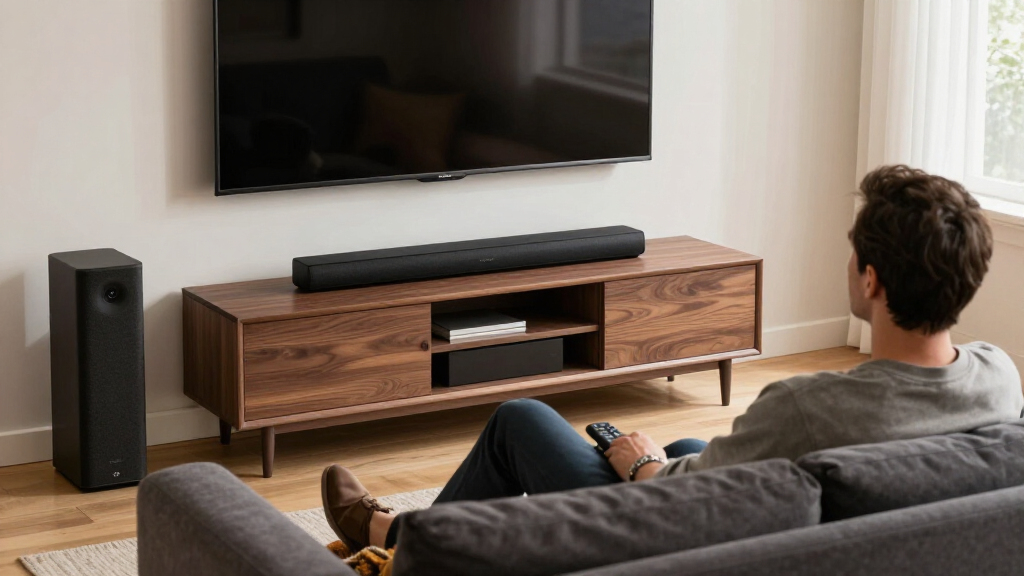
I compared the 15 systems by how well their design serves buyers choosing specifically for a wireless subwoofer soundbar: channel layout, dialogue support, surround and height effects, connection and control options, and likely setup demands. I also weighed whether a system’s extra speakers or processing add a meaningful benefit for its intended buyer, since a higher channel count can mean more placement work as well as a broader soundstage.
The ranking favors useful performance with manageable setup across common living rooms. Systems with dedicated center or height channels earn distinction when those features address dialogue or immersion, while compact 2.1 models remain relevant for straightforward upgrades. Rear-speaker systems are positioned for buyers who value surround coverage enough to accommodate more components. Every pick has a tradeoff, including limits in channel layout, placement flexibility, or the scale of its feature set.
Factors to Consider When Choosing Soundbars With Wireless Subwoofers
Before choosing a model, I’d match the speaker layout and physical setup to the room and the way you watch. These factors help explain when a wireless subwoofer system’s added channels are useful and when a simpler bar is the more sensible fit.
Choose channels for the sound you want
A 2.1 system pairs a stereo soundbar with a subwoofer, making it a direct upgrade for TV sound and low-frequency effects. A 3.1 layout adds a center channel, which can give dialogue a more defined place in the mix. Systems with height channels process or direct sound to create a more overhead impression, while rear speakers can make surround effects feel more enveloping. Channel labels describe a layout, but they do not guarantee the same result across rooms or content. If you mostly watch dialogue-heavy shows, center-channel support may matter more than a high channel count. For films with immersive mixes, check which surround features the system actually includes and whether you can position its speakers as intended.
Plan subwoofer placement and power
Wireless describes how the subwoofer receives audio from the bar; it still needs a power outlet. Think through the room before buying, including whether there is a practical spot near the TV and an outlet within reach. A subwoofer hidden in a tight cabinet or placed far from the listening area may not deliver the experience you expect. Bass can also sound different depending on its location, so a little flexibility to move it helps. The soundbar itself needs a clear position near the TV, and rear speakers require space if the package includes them. A smaller room may be better served by a compact system that is easy to place than by a larger bundle whose pieces are hard to accommodate.
Check TV connections and everyday controls
Confirm which audio connections the bar supports and which outputs your TV provides before choosing a system. HDMI ARC or eARC can simplify sending TV audio to a soundbar, but compatibility depends on the ports and settings on both devices. Optical and Bluetooth connections may suit some setups, though they can limit control or audio options compared with HDMI. Consider how you want to adjust volume and sound modes: a familiar TV remote, the soundbar’s remote, or an app can each suit a different household. Extra inputs matter if you plan to connect sources directly to the bar. A connection that works with your current TV can save setup friction and help the system fit into everyday use.
Match the system to your room and listening habits
Open-plan rooms, enclosed living rooms, and bedrooms place different demands on a soundbar and subwoofer. A larger space may benefit from more speakers or a broader soundstage, while a small room can make intense bass and extra components less useful. Consider how far you sit from the TV and whether the room has walls that can support reflected surround or height effects. If you watch mostly news and series, prioritize understandable speech and easy volume control. For films and games, think about surround placement and the formats your sources use. The right choice follows your listening habits and room layout rather than the biggest channel number on the box.
Decide when extra speakers are worth the setup
Rear speakers can create a more convincing sense of sounds coming from behind you, but they add placement decisions and more hardware to manage. A system that relies on virtual surround can be easier to install and keep tidy, though its effects depend on the room and listening position. Ask whether you have clear spots behind or beside the seating area before paying for a package with rear speakers. Height effects also vary with room shape and ceiling, so a supported format alone does not promise a strong overhead impression. A simpler bar may be the better fit if you want an easy TV upgrade with minimal setup. Extra components make more sense when you can place them well and will watch content that uses their capabilities.
Prioritize features you will use
Sound modes, app controls, Bluetooth, and format support can all be useful, but their value depends on your routine. A dedicated dialogue mode may help when voices are hard to follow, while an app can make sound adjustments easier from the sofa. Bluetooth can let you play music from a phone, though it may not replace a proper TV connection. Match format support to the devices and content you already use, rather than treating every logo as a reason to upgrade. Simpler controls can be a benefit in a shared household where everyone needs to adjust the volume. Keep your shortlist focused on features that solve a real problem in your setup.
Frequently Asked Questions
Will a wireless subwoofer work without Wi-Fi?
In these systems, wireless generally means the subwoofer connects to the soundbar without an audio cable; it does not mean it runs on a home Wi-Fi network. The subwoofer still needs power, and it needs to pair with the compatible bar. Check the product’s setup instructions for pairing steps and any placement limits. If you are trying to avoid cables across the room, this design can help with audio wiring, but it will not remove the power cord. Make sure you have an outlet near the spot where you want to put the subwoofer.
Should I choose a 3.1 soundbar over a 2.1 model for clearer dialogue?
A 3.1 layout includes a center channel, which gives dialogue a dedicated channel in compatible content and may help keep voices distinct from effects. A 2.1 system can still improve TV sound, but it does not have that separate center speaker. The room, TV position, source mix, and soundbar processing all affect what you hear, so the channel number alone cannot promise clearer speech. If you often turn captions on because voices are hard to follow, a model with a center channel is a useful feature to prioritize. Also check whether the bar offers dialogue adjustment or a speech-focused mode.
Do I need rear speakers to get surround sound?
No. Some soundbars use processing or upward and side-firing drivers to create a wider or more immersive impression without separate rear speakers. Physical rear speakers can place effects behind the listening position more directly, but they require space and setup. Virtual effects may be less convincing when the room shape or seating position falls outside the system’s intended layout. Consider whether your sofa has practical speaker locations before choosing a rear-speaker bundle. If you want fewer components, a system designed to create surround effects from the bar may be easier to live with.
Can I place the wireless subwoofer inside a TV cabinet?
That depends on the cabinet’s size, ventilation, and the subwoofer’s design, but an enclosed space can change or muffle bass. A cabinet may also limit the driver’s movement or cause objects and panels to rattle. Leave room around the unit and follow the manufacturer’s placement guidance. Try the subwoofer in more than one open location if the bass sounds weak or boomy. Since the subwoofer needs power, check outlet access before settling on a cabinet position.
Is a Dolby Atmos soundbar worth choosing if my room has a low ceiling?
Atmos support can still be useful with a low ceiling, but overhead effects from up-firing drivers depend on sound reflecting off the ceiling and returning to your seat. A very high, angled, or acoustically unusual ceiling can make those effects less distinct. The system may still provide other benefits, such as a broader soundstage or additional channels, depending on its design. Check the speaker layout and room guidance rather than choosing by the format label alone. If your room is not suited to reflected effects, clear dialogue and well-placed surround speakers may matter more to you.
Conclusion
I’d choose the Samsung HW-Q800F as the best overall for buyers who want height channels and a wireless subwoofer without adding rear speakers. For best value and a straightforward first upgrade, the Samsung HW-B550F or Hisense HS2100 makes more sense if a 2.1 layout fits your needs. The JBL Bar 500MK2 is my premium pick for an Atmos-focused setup that avoids separate rear speakers, while the Samsung HW-Q990H suits buyers who want a fuller system with rear speakers and have room to place them. For dialogue-centered viewing, I’d shortlist the LG S60T or Samsung HW-B630F; for a compact, simple setup, compare the Polk Audio Signa S2 and TCL S55H. Pick the system whose channels, connections, and speaker placement fit your room and habits.
Fall Picks
fall essentials
As an affiliate, we earn on qualifying purchases.