TL;DR

Get business pricing on your home office setup
- Business-only prices and quantity discounts
- Tax-exempt purchasing
- Multiple users, one account, clear invoices
Interior designers Kate Marker and Jessica Kain Barton recommend combining decorative overhead fixtures with task lighting rather than relying only on recessed lights. They favor warm 2700K bulbs for general dressing-room lighting, 3000K for vanities, and dimmers to adjust the atmosphere.
A Veranda report on dressing-room design features advice from interior designers Kate Marker and Jessica Kain Barton: combine a decorative ceiling fixture with softer, task-focused lights, and use warm bulbs and dimmers to balance comfort with visibility. Their recommendations address a practical challenge in a small space used both for getting dressed and for tasks such as applying makeup.
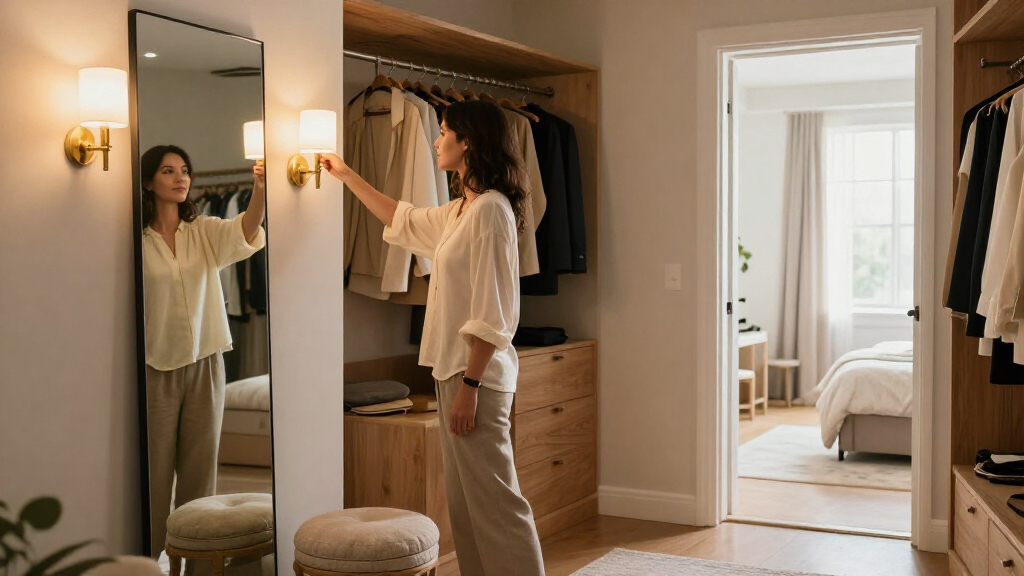
Marker recommends layering ambient and task lighting rather than expecting one fixture to do everything. A pendant or small chandelier can provide an expressive focal point, while sconces beside a mirror bring light closer to the face. She says face-level lighting helps reduce shadows while someone is getting ready. Barton also favors overhead fixtures, including chandeliers, lanterns or flush mounts, and says she looks for designs with at least three or four candle bulbs.
Both designers caution against relying on recessed lights alone. Marker says they can feel harsh and create unflattering shadows. If recessed lighting is needed, Barton recommends using no more than four fixtures, preferably mud-in style, and keeping them no wider than three inches in diameter. Those are her design preferences, not a universal lighting rule or a substitute for project-specific electrical guidance.
For general dressing-room lighting, Marker and Barton favor 2700K bulbs, which provide a warmer glow. For vanity lighting, Marker recommends 3000K bulbs with excellent color rendering. She also advises putting decorative lights on dimmers, allowing users to adjust the room’s brightness and mood. The report does not identify a particular bulb model or specify a color-rendering metric.
Lighting for Dressing and Makeup
The recommendations address two needs that can compete in a dressing room: light should be comfortable and visually flattering, but it must also be useful for choosing clothes and grooming. A single overhead source may leave shadows on the face, while a mix of ceiling and mirror-level fixtures can provide different kinds of illumination. The designers’ advice gives readers a way to think about fixture placement, not just style.
Color temperature and dimming also affect how a compact, private room feels through the day. Marker and Barton’s suggested bulb temperatures offer a starting point, while dimmers let occupants adjust brightness for different tasks. The report presents these as professional preferences; it does not establish that the same setup will suit every room, mirror, finish or user.
Popular right now

Hisense 43-Inch E6 Cinema Series Hi-QLED 4K UHD Smart Fire TV (43E6QF)

Hisense 40-Inch Class QD4SR Series Hi-QLED FHD Smart Roku TV (2026 Model)

De’Longhi Classic Matte Black Espresso Machine with Milk Frother
As an affiliate, we earn on qualifying purchases.
From Boudoir to Modern Dressing Room
The report places dressing rooms in a longer history, noting that private dressing spaces—known as boudoirs in France—appeared in English and European homes and estates during the 17th century. They offered privacy for dressing and other personal activities. The contemporary design focus, by contrast, includes how to make the space functional as well as intimate.
Marker describes a dressing room as a personal boutique and says it should feel beautiful and individual. The report also points to materials and furnishings that can support that character, including fabric shades, warm metal finishes, wallpaper, window treatments and mirrors. These details are presented as complementary design choices, rather than substitutes for a considered lighting plan.
“My biggest must-do [when decorating a dressing room] is layering lighting. You want a combination of ambient and task lighting so the room feels warm and inviting but is still functional.”
— Kate Marker, interior designer
Room Conditions Affect the Plan
The report offers designers’ general preferences, not a measured comparison of lighting layouts or a prescription for every dressing room. It does not provide room dimensions, fixture spacing, electrical plans or specific product recommendations. The right number and placement of fixtures will depend on the room, mirror location, existing wiring and the tasks being done. Its bulb-temperature suggestions also do not, by themselves, specify color accuracy; the report gives no color-rendering score for the recommended vanity bulbs.
Barton’s limits for recessed lights are her own design guidance. The report does not address local electrical codes, installation requirements or whether a particular ceiling can accommodate a chosen fixture. Those details need to be checked for each project.
Apply the Advice to Your Room
The report does not announce a new standard or a follow-up project; it offers practical suggestions readers can weigh against their own rooms. A useful next step is to map where overhead light, mirror-level task lighting and any vanity lighting are needed, then consider warm bulbs and dimmers as part of the plan. Before buying fixtures, check their dimensions and compatibility with the space and controls.
For electrical changes or new fixture installation, consult a licensed electrician and follow applicable local codes. The source does not specify installation procedures, so readers should not treat its design advice as wiring instructions.
Key Questions
What types of lights do the designers recommend for a dressing room?
They recommend layering a decorative ceiling fixture, such as a pendant or chandelier, with task lighting such as sconces near a mirror or vanity.
What bulb temperature does the report recommend?
Marker and Barton favor 2700K bulbs for general dressing-room lighting. Marker recommends 3000K bulbs with excellent color rendering at a vanity.
Should recessed lighting be used in a dressing room?
Marker advises against relying on recessed lighting alone because it can feel harsh and create shadows. Barton suggests no more than four small, mud-in recessed lights if they are needed; this is her design preference, not a universal rule.
Why put dressing-room lights on dimmers?
Marker says dimmers make it possible to adjust brightness and change how the room feels. The report does not specify a particular dimmer or compatibility requirements.
Does the report provide installation or electrical instructions?
No. It provides design guidance, not wiring or code instructions. For electrical work, consult a licensed electrician and follow applicable local requirements.
Source: veranda.com