TL;DR

Get business pricing on your home office setup
- Business-only prices and quantity discounts
- Tax-exempt purchasing
- Multiple users, one account, clear invoices
House Beautiful published a collection of 27 designer examples showing ways to conceal or visually blend televisions in homes. The approaches include cabinets, millwork, closets, credenzas, artwork, fabric, and a pop-up mechanism; the report does not provide pricing or comparative performance data.
House Beautiful has published a report featuring 27 designer approaches to hiding or blending televisions in homes, offering alternatives for people who want a screen to be less prominent when not in use. The examples range from cabinet doors and millwork to screens disguised as artwork or integrated into furniture.
The report’s examples show that concealment can involve either physically covering or storing a television or making it visually fit its surroundings. Melbourne designer Kylie Buhagiar, of Golden, describes a wall-mounted metal joinery box with hinged doors that stack back to reveal the screen. Vancouver designer Gillian Segal used a folding millwork door system, which she said suited a room used both as a formal living space and a family room.
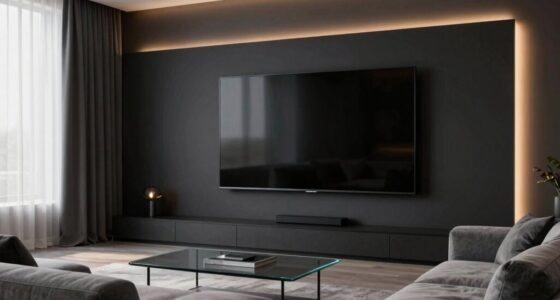
Other examples place televisions inside a closet, cabinet, or credenza, or behind fabric-covered glass. Some instead reduce visual contrast: a black-painted accent wall can camouflage a screen, while a Samsung Frame television can display an image and be matched to the room’s decor. The report also features a television hidden behind abstract-looking panels above a fireplace and one concealed by a bi-fold painting.
More built-in approaches include a floating credenza made with custom steel and walnut and an outdoor cabinet above a fireplace. The report also describes a pop-up function in a formal living room, though the supplied material does not provide its operating details. The examples are presented as individual design projects, not as a tested comparison of cost, installation difficulty, or suitability for every home.
Design Choices Beyond the Screen
The collection addresses a common design tension: televisions are useful for entertainment, but a large dark screen can draw attention in a room when it is switched off. The examples show how designers handle that tension through storage, cabinetry, materials, and visual coordination, rather than treating the television as a standalone object.
The options have different practical trade-offs. A closet or cabinet can hide a screen entirely, while a Frame-style display or a matching frame leaves it visible but makes it resemble part of the decor. Built-in doors and pop-up hardware may require more planning than using furniture already in a room. The report does not establish which option is least expensive or best for a particular household; readers would need to account for room layout, ventilation, access, wiring, and how often the screen is used.
Popular right now

Shark Navigator Lift-Away Upright Vacuum Cleaner, White (NV356E)

KitchenAid Artisan 5-Qt Tilt-Head Stand Mixer – Dried Rose (KSM150PS)

Hisense 55-Inch E6SR Series Hi-QLED 4K UHD Smart Roku TV (2026 Model)
As an affiliate, we earn on qualifying purchases.
From Cabinets to Camouflage
The report brings together 27 residential design examples and describes a range of approaches rather than one new product or construction method. Some designers make the television disappear behind movable panels; others reduce its visual impact by matching its frame, color, or placement to nearby features.
In one project, designer Ariel Okin added a frame to a Samsung Frame television so it echoed other room details, including a fireplace screen. Designer Denise McGaha used a Frame display as a photograph-like element in a blue-and-gray sitting area. These differ from the more complete concealment in a guest-room closet or behind a cabinet’s hinged doors. Architect Ken Pursley described a bi-fold painting with visible bronze hinges as “true kinetic art,” a design that acknowledges the panel moves rather than pretending it is a fixed painting.
““In the main living room, the TV is discreetly integrated into a wall-hung metal joinery box, with hinged doors that elegantly stack back to reveal the screen when needed.””
— Kylie Buhagiar, designer at Golden
Costs and Installation Details
The supplied report material does not give cost estimates, measurements, installation instructions, or product specifications for the 27 examples. It also does not compare how well the approaches work across different screen sizes, rooms, or patterns of use. Details for the pop-up mechanism are limited in the supplied excerpt.
It is also not clear which projects require custom construction or professional installation beyond the descriptions of bespoke millwork and built-in features. Homeowners considering a similar design would need to confirm that doors and coverings allow adequate ventilation and that the screen, cables, and moving parts remain accessible. The article is an inspiration roundup, not technical guidance.
Choosing a Solution for Each Room
The next step for anyone adapting these ideas is to match the approach to the room and the way the television is used: a cabinet or closet for full concealment, coordinated framing for a screen that stays visible, or custom millwork where a built-in finish is desired. Before commissioning work, homeowners can check dimensions, cable routes, ventilation, door clearance, and access to controls.
House Beautiful’s report supplies visual examples but does not announce a follow-up or identify a single preferred design. Costs, technical requirements, and project-specific performance remain matters for designers, installers, or product manufacturers to confirm.
Key Questions
What is the main news in the report?
House Beautiful published 27 designer examples of ways to hide or visually blend televisions in residential interiors.
What are some ways to conceal a television?
The examples include cabinet doors, millwork, closets, credenzas, fabric-covered glass, and a bi-fold painting. Other approaches camouflage the screen with paint or make it resemble a framed image.
Does the report say which option costs the least?
No. The supplied material gives no comparative prices. Segal described her folding millwork door system as cost-effective, but the report does not provide a price or compare it with the other designs.
Are the ideas installation instructions?
No. The report presents design examples, not technical guidance. Anyone planning a built-in or moving mechanism should confirm ventilation, wiring, clearances, and access with an appropriately qualified installer.
Source: housebeautiful.com