For most home studios, the 4-Pack Acoustic Foam Panels, 48 × 24 × 2 in is the strongest overall pick because its large, thick panels can cover broad reflection areas with fewer pieces. The TONOR Dual-Layer Self-Adhesive Panels stand out for a simpler wall setup, while the TroyStudio Thickened Acoustic Felt Panels offer a different material and a compact format. The main tradeoff is between broad coverage, panel thickness, installation effort, and how much wall space you can spare. A key distinction: acoustic panels reduce room reflections and echo, but they do not block sound from entering or leaving a room. Read on for the full comparison and guidance on matching a panel type to your studio.

Get business pricing on your home office setup
- Business-only prices and quantity discounts
- Tax-exempt purchasing
- Multiple users, one account, clear invoices
Complete the kit


Key Takeaways
- Large 2-inch panels cover more wall per piece than 12-inch foam tiles, which can mean fewer seams and a simpler layout for treating reflection points.
- Self-adhesive panels favor convenience, but fixed placement can make them harder to reposition or remove cleanly than panels installed with separate adhesive.
- High piece counts do not automatically mean better treatment. Coverage depends on each tile’s dimensions, thickness, and where you place it.
- Thin, wide TONOR panels suit a different goal from thick foam. Their slim profile may fit a restrained wall treatment, while offering less depth than 2-inch options.
- Acoustic foam and felt panels address room sound, not sound leakage. Doors, windows, gaps, and wall construction still matter when noise isolation is the real problem.




| soundproofing panels for home studio | Quantity | Brand | Panel dimensions | Material |
|---|---|---|---|---|
| Saiqiang Acoustic Foam Panels | — | Saiqiang | 1 x 12 x 12 inches | — |
| TONOR Dual-Layer Self-Adhesive | 4 panels | TONOR | 47.2 × 23.6 × 0.72 inches | High-density polyester fiber |
| 24-Pack 2-Inch Thick Pyramid A | 24 panels | — | — | Flame-retardant acoustic foam |
| 4-Pack Acoustic Foam Panels | 4 panels | — | 48 × 24 × 2 inches | High-density polyurethane foam |
| TONOR Self-Adhesive Acoustic P | 8 panels | TONOR | — | Polyester fiber |
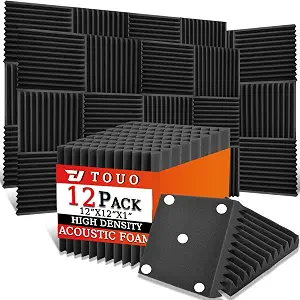
| TOUO 12-Pack Acoustic Foam Pan | 12 panels | — | 12 x 12 x 1 inches | Polyurethane foam |
| Focusound 80-Pack Acoustic Foa | 80 panels | Focusound | 12 x 12 x 1 inches | — |
| Saiqiang 56-Pack Acoustic Foam | 56 panels | Saiqiang | 12 x 12 x 1 inches | Acoustic foam |
| Focusound 52-Pack Acoustic Foa | 52 panels | Focusound | 12 x 12 x 1 inches | — |
| JBER 12-Pack Acoustic Foam Pan | 12 panels | JBER | 12 x 12 x 1 inches per panel | Polyurethane foam |
| Focusound 50-Pack Acoustic Foa | — | Focusound | 12 × 12 inches | — |
| Geynnple High-Density Soundpro | 1 panel | Geynnple | — | Polyester |
| Focusound Acoustic Foam Panels | 120 panels | Focusound | 12 × 12 inches | Foam |
| NEPIS Self-Adhesive Acoustic F | 20 panels | NEPIS | 11.8 × 11.8 × 0.36 inches | Polyester |
| TroyStudio Thickened Acoustic | — | — | — | 100% polyester fiber |
More Details on Our Top Picks
Saiqiang Acoustic Foam Panels, 12 Pack, 1 x 12 x 12 Inches, Black
The Saiqiang 12-pack suits a home-studio owner who wants to tame reflections in a defined area, such as behind a microphone or around a desk, without covering entire walls. Its one-inch wedge foam is designed to reduce echo, not stop sound passing through walls; for broader surface coverage, the TONOR 8-pack uses much larger panels and lists an NRC figure. Saiqiang’s smaller tiles are easier to arrange around outlets and corners, but the limited pack size means they are less suited to treating a whole room. The panels arrive vacuum packed and may need 24–48 hours to expand. Included nano tape offers a simpler mounting route than the pyramid foam pack, which requires separate adhesive or tape. I’d choose this for targeted reflection control, not noise isolation.
Pros:- Wedge shape is intended to reduce room echo and sound reflections
- Compact 12-by-12-inch panels are easier to place around small studio features
- Includes nano double-sided tape and can also be installed with construction adhesive
- Two-year warranty is listed
Cons:- One-inch foam and a 12-panel pack offer limited coverage for larger rooms
- Does not provide structural sound isolation or block outside noise
- Panels may take 24–48 hours to expand after unpacking
Best for: Home podcasters or musicians treating a small first-reflection area near a desk or microphone
Not ideal for: Studio owners seeking wall-to-wall coverage or a barrier against neighbors, traffic, or sound leakage
- Brand:Saiqiang
- Pack size:12 panels
- Panel dimensions:1 x 12 x 12 inches
- Shape:Wedge
- Color:Black
- Installation:Construction adhesive or included nano double-sided tape
- Expansion time:24–48 hours
- Warranty:2 years
Our verdict“Choose Saiqiang for targeted echo control in a compact studio, but pick the TONOR 8-pack for broader coverage and a stated absorption rating.”
TONOR Dual-Layer Self-Adhesive Acoustic Wall Panels, 4-Pack
These four oversized polyester panels are a better fit for a deliberate wall treatment than the small Saiqiang foam tiles: each measures 47.2 by 23.6 inches and can be cut to suit a recording nook or selected reflection points. The dual-layer construction is intended to reduce echo, while the stripe pattern reads more like wall decor than conventional wedge foam. Peel-and-stick backing also avoids sourcing separate mounting tape, though the wall surface needs to suit adhesive installation. Compared with the TONOR 8-pack, this set has fewer, thicker-feeling panels by description but no stated NRC or verified coverage figure, so buyers have less concrete absorption information for planning. It may help control room reflections; the supplied details do not establish meaningful sound isolation from adjacent rooms.
Pros:- Large panels can cover broad wall sections with fewer seams
- Dual-layer polyester construction is designed to disperse echo and noise
- Self-adhesive backing simplifies installation
- Panels can be cut to fit the treatment area
Cons:- Listed coverage is unverified, making layout planning less certain
- No sound-isolation performance is established by the provided details
- Adhesive mounting may not suit every wall finish
Best for: Home-studio owners who want large, cuttable panels with a finished decorative look and straightforward adhesive mounting
Not ideal for: Buyers who need documented absorption performance, verified coverage, or a barrier against sound traveling through walls
- Brand:TONOR
- Quantity:4 panels
- Panel dimensions:47.2 × 23.6 × 0.72 inches
- Material:High-density polyester fiber
- Construction:Dual-layer
- Installation:Self-adhesive, peel and stick
- Weight:7500 g
- Warranty:2 years
Our verdict“Pick this set for a neat, adaptable wall treatment, but choose the TONOR 8-pack if a stated NRC and coverage figure matter more.”
24-Pack 2-Inch Thick Pyramid Acoustic Foam Panels
For a buyer prioritizing foam depth over decorative wall panels, this 24-piece, two-inch pyramid set is the most clearly specified foam option in this group. The pyramid surface is intended to increase exposed area, while the extra thickness makes it a more substantial treatment than Saiqiang’s one-inch wedges. That does not make it a sound barrier: the product is explicitly intended for absorption, not noise isolation, so it will not keep a loud instrument from reaching another room. Its flame-retardant description may matter when choosing studio materials, but installation takes extra planning because tape or construction adhesive is not included. Compared with the large TONOR fiber panels, these smaller foam pieces allow a more segmented layout but require more individual placement and mounting work.
Pros:- Two-inch thickness provides a deeper foam profile than the one-inch Saiqiang panels
- Pyramid design is intended to help reduce echo and reverberation
- Flame-retardant foam is specified
- Twenty-four pieces allow a segmented wall or ceiling arrangement
Cons:- Does not block outside noise or provide full soundproofing
- Adhesive or double-sided tape must be supplied separately
- Individual panels require more placement work than oversized fiber panels
Best for: Musicians building a reflection-control layout who want two-inch foam and are comfortable sourcing mounting supplies
Not ideal for: People trying to block outside noise or those who want a large-area peel-and-stick treatment with minimal installation work
- Quantity:24 panels
- Thickness:2 inches
- Design:Pyramid
- Material:Flame-retardant acoustic foam
- Installation:Construction adhesive or double-sided tape, not included
- Intended use:Sound absorption
- Sound isolation:Not intended to block external noise or provide sound isolation
Our verdict“Choose this set for a segmented, thicker foam treatment when you can supply the adhesive and do not expect it to isolate sound between rooms.”
4-Pack Acoustic Foam Panels, 48 × 24 × 2 in
These four 48-by-24-inch panels make sense for a studio owner who prefers a few broad foam sections instead of arranging many small tiles. At two inches thick, they share the thickness of the pyramid foam pack but cover much larger individual areas, which can simplify a wall or ceiling layout. The tradeoff is sparse performance detail: the listing describes high-density polyurethane foam and flame retardancy, but gives no quantified noise-reduction result or installation method. That leaves buyers to confirm how the panels should be mounted and what effect to expect. Compared with the TONOR 8-pack, this set offers thicker foam panels but lacks a stated NRC and listed total coverage. I’d favor it for large, planned treatment zones where the buyer can resolve mounting and performance questions before installation.
Pros:- Large 48-by-24-inch panels cover broad areas with fewer pieces
- Two-inch thickness is suitable for a deeper foam treatment than thin wall panels
- High-density polyurethane foam is specified
- Described as flame retardant and suitable for wall or ceiling use
Cons:- No installation hardware or mounting method is specified
- Noise-reduction performance is not quantified
- Four panels may not cover an entire room
Best for: Studio owners who want a small number of large, two-inch foam panels for selected wall or ceiling sections
Not ideal for: Buyers who need a documented absorption rating, included mounting hardware, or proven isolation from outside noise
- Quantity:4 panels
- Panel dimensions:48 × 24 × 2 inches
- Material:High-density polyurethane foam
- Color:Black
- Item weight:6.8 lb
- Fire resistance:Described as flame retardant
- Package dimensions:12.8 × 10.98 × 7.68 inches
Our verdict“Pick these panels for broad, thick foam coverage if you can confirm mounting needs, but favor the TONOR 8-pack for clearer absorption specifications.”
TONOR Self-Adhesive Acoustic Panels, 8-Pack, 47.2 x 23.6 x 0.35 in
The TONOR 8-pack earns the broadest recommendation here for studio owners who want substantial wall coverage without separate mounting hardware. Its listed 61.1-square-foot coverage and NRC of 0.9 give buyers more useful planning information than the four-panel TONOR set, whose coverage figure is unverified. The tradeoff is its slim 0.35-inch profile: these polyester panels are designed to absorb sound and reduce echo, but they are not a substitute for construction changes that block sound from entering or leaving a room. Peel-and-stick mounting is convenient on smooth surfaces, yet may limit placement on textured or unsuitable walls. Compared with the two-inch pyramid foam, this option favors a clean, expansive wall treatment over thicker individual foam pieces. It is the strongest fit for taming reflections across a home studio wall.
Pros:- NRC of 0.9 provides a stated absorption rating
- Eight large panels list total coverage of 61.1 square feet
- Self-adhesive installation avoids separate mounting hardware on smooth surfaces
- Odorless polyester fiber is specified
Cons:- At 0.35 inches thick, panels have a slimmer profile than the two-inch pyramid foam
- Adhesive installation is intended for smooth surfaces
- Echo absorption does not establish sound blocking between rooms
Best for: Home musicians, voiceover artists, and podcasters seeking broad, simple-to-install echo treatment on smooth walls
Not ideal for: Studio owners needing sound isolation, mounting on rough surfaces, or a thicker foam profile for targeted treatment
- Brand:TONOR
- Quantity:8 panels
- Dimensions:47.2 x 23.6 x 0.35 inches
- Coverage:61.1 sq ft
- NRC:0.9
- Density:212.2 kg/m³
- Material:Polyester fiber
- Installation:Self-adhesive, peel and stick
- Warranty:2 years
Our verdict“Choose the TONOR 8-pack for broad, easy-to-plan reflection control on smooth walls, not for sound isolation or thick foam treatment.”
TOUO 12-Pack Acoustic Foam Panels, 12 x 12 x 1 Inch, Black
The TOUO 12-pack suits a home-studio owner who wants to treat a small reflection area rather than cover an entire room. Its 12 one-inch foam squares are intended to tame echo and reverb, while the included 60 adhesive pieces spare you a separate mounting-materials search. Compared with the JBER 12-Pack, TOUO also supplies adhesive, though JBER lists a density and an NRC figure that TOUO’s product data does not provide. That makes TOUO the simpler installation-ready choice, not the more documented performance pick. The foam can be cut to fit awkward spots, but its thin profile is for room sound treatment, not blocking sound through walls. Allow 24–48 hours for the panels to recover after unpacking, and keep expectations modest: 12 square feet is limited coverage for a full studio.
Pros:- Includes 60 double-sided adhesive pieces for mounting
- Can be cut to fit smaller or irregular areas
- Designed to reduce room echo and reverberation
- Product description identifies the foam as flame-resistant
Cons:- 12 panels provide limited coverage for a full studio
- May need 24–48 hours to recover after unpacking
- Absorbs reflections but does not block sound through walls
Best for: Home-recording beginners treating a small vocal or reflection area who want mounting tape included.
Not ideal for: Anyone treating a whole room or trying to stop sound from reaching neighbors; this small, one-inch foam set does not provide structural sound isolation.
- Quantity:12 panels
- Panel dimensions:12 x 12 x 1 inches
- Material:Polyurethane foam
- Color:Black
- Weight:14.9 ounces
- Included accessories:60 double-sided adhesive tape pieces
- Flame resistance:Product description says it self-extinguishes within 1 minute
- Model number:02(25)SJC-Black012
Our verdict“Choose TOUO for a small, targeted studio treatment when included adhesive matters more than broad coverage or published performance details.”
Focusound 80-Pack Acoustic Foam Panels, 1 x 12 x 12 Inches, with 420 Double-Sided Adhesive Pieces
For a studio with several untreated walls, the Focusound 80-pack offers the most panels in this group, making it easier to spread treatment across multiple reflection points. The set includes 420 adhesive pieces, a larger supply than the 300 included with the Focusound 52-pack, which can help when laying out a broad grid. Both Focusound sets use one-inch-thick squares, so the extra quantity adds coverage rather than deeper absorption; neither should be mistaken for sound isolation or a fix for bass traveling through walls. This option makes the most sense when room coverage is the priority and you have time to plan placement. The foam may need 24–48 hours to regain its shape after soaking and air-drying, and the supplied information does not give a panel density or thickness advantage over smaller packs.
Pros:- Largest panel quantity among the products in this batch
- Includes 420 double-sided adhesive pieces
- Suitable for studios, vocal booths, home offices, and control rooms
- Described as fire-resistant and made with non-toxic materials
Cons:- One-inch thickness is intended for echo control, not sound isolation
- Panels may need 24–48 hours to regain their shape after soaking and air-drying
- Large quantities require more planning and wall space than a small targeted kit
Best for: Home-studio owners treating several wall areas or building a vocal-room layout who want a large panel count and adhesive in the box.
Not ideal for: Buyers with a tiny recording nook or anyone seeking thicker treatment or sound blocking; the one-inch panels may be more coverage than needed without addressing sound transmission.
- Brand:Focusound
- Quantity:80 panels
- Panel dimensions:12 x 12 x 1 inches
- Included adhesive:420 double-sided adhesive pieces
- Model number:FS0302H
- Recommended uses:Recording studios, home offices, vocal booths, and control rooms
- Material information:Described as non-toxic foam
- Fire property:Described as fire-resistant
Our verdict“Pick the Focusound 80-pack when broad wall coverage and included mounting pieces matter more than thicker treatment.”
Saiqiang 56-Pack Acoustic Foam Panels, 1 x 12 x 12 Inches, Black
The Saiqiang 56-pack is a useful middle ground for studio owners who want more than a starter set but do not need the 80 panels in the larger Focusound kit. Its wedge shape and light weight suit placement on walls, doors, or ceilings, giving you flexibility to treat selected reflection areas. Unlike both Focusound packs in this batch, Saiqiang does not include adhesive, so mounting materials add a separate task and may affect how you arrange the panels. The panels are one inch thick and are described as fire-resistant, but they reduce echo rather than stop sound passing through a wall. Plan for 24–48 hours of expansion after unpacking. This is a practical choice for a custom layout, but less convenient for buyers who want a ready-to-mount kit.
Pros:- 56 panels offer more coverage than the TOUO and JBER 12-packs
- Wedge shape and light weight allow placement on walls, doors, or ceilings
- Suitable for studios, offices, and home theaters
- Described as fire-resistant
Cons:- Adhesive or double-sided tape is not included
- May take 24–48 hours to fully expand after unpacking
- Reduces reflections but does not provide structural sound isolation
Best for: DIY home-studio owners who want a moderate quantity of lightweight panels and already have a preferred mounting method.
Not ideal for: People who want an all-in-one installation kit or expect foam to isolate a studio from outside noise; adhesive is not included and the panels do not provide structural soundproofing.
- Brand:Saiqiang
- Quantity:56 panels
- Panel dimensions:12 x 12 x 1 inches
- Color:Black
- Shape:Wedge
- Material:Acoustic foam
- Fire resistance:Described as fire-resistant
- Installation:Construction adhesive or double-sided tape, not included
- Expansion time:24–48 hours
Our verdict“Choose Saiqiang for a flexible mid-size treatment layout if you are prepared to supply your own mounting materials.”
Focusound 52-Pack Acoustic Foam Panels, 1 × 12 × 12 in, with 300 Double-Sided Adhesive Pieces
The Focusound 52-pack balances a useful panel count with installation supplies, making it a more contained project than the 80-panel Focusound set. Its 300 adhesive pieces give you a way to mount the panels without sourcing tape separately, while the triangular grooves are designed to absorb reflections and reduce reverberation around recording positions. Compared with the Saiqiang 56-pack, it has four fewer panels but includes adhesive; Saiqiang offers a wedge profile and more placement options, though its mounting materials are sold separately. Focusound’s one-inch thickness keeps the panels suited to echo control rather than sound isolation or substantial low-frequency treatment. The foam can be reshaped by soaking and air-drying, but that process takes 24–48 hours, so it is not a quick setup option if the panels arrive compressed.
Pros:- Includes 300 double-sided adhesive pieces
- 52 panels provide a middle ground between small kits and the 80-pack
- Triangular grooves are designed to reduce echoes and reverberation
- Foam can be reshaped by soaking and air-drying
Cons:- One-inch panels are limited to relatively shallow reflection treatment
- Reshaping requires 24–48 hours of air-drying
- Does not block sound from passing through walls
Best for: Home-studio owners treating a few recording and listening areas who want included adhesive without committing to an 80-panel set.
Not ideal for: Buyers who need deep acoustic treatment, sound isolation, or a large wall-coverage pack; these one-inch panels are aimed at managing reflections.
- Brand:Focusound
- Quantity:52 panels
- Panel dimensions:12 x 12 x 1 inches
- Adhesive included:300 double-sided adhesive pieces
- Model:FS0302F
- Recommended uses:Home offices, recording studios, vocal booths, and control rooms
- Surface design:Triangular grooves
- Reshaping method:Soak and air-dry for 24–48 hours
Our verdict“Pick this Focusound set for a moderate studio treatment project when included adhesive is more useful than the extra panels in the 80-pack.”
JBER 12-Pack Acoustic Foam Panels, 1 × 12 × 12 Inches, Black
The JBER 12-pack stands out among the small kits because its product data gives buyers more performance detail: it lists a density of 30 kg/m³ and an NRC greater than 0.8. Those figures make it easier to compare on paper than the TOUO 12-pack, though both offer just 12 one-inch panels and target echo reduction rather than sound blocking. JBER’s stated 12-square-foot coverage suits a focused patch of wall or ceiling, and the panels can be trimmed for irregular spaces. The tradeoff is that glue, tape, or nails are not included, so mounting takes extra planning. Compared with the adhesive-equipped TOUO kit, JBER is the more specification-forward option, not the simpler installation choice. It also should not be treated as a substitute for thicker panels when deeper acoustic control is the goal.
Pros:- Lists a density of 30 kg/m³ and an NRC greater than 0.8
- Covers 12 square feet
- Can be trimmed for irregular spaces
- Flame-retardant material is specified
Cons:- Glue, tape, or nails are not included
- 12 panels are not enough for broad room treatment
- Echo absorption does not block sound through walls
Best for: Home-studio owners treating a specific reflection area who want listed density and NRC information and can provide their own mounting materials.
Not ideal for: Buyers wanting adhesive included, extensive room coverage, or sound isolation; this 12-panel, one-inch set is limited in both coverage and function.
- Brand:JBER
- Quantity:12 panels
- Panel dimensions:12 x 12 x 1 inches per panel
- Coverage area:12 square feet
- Material:Polyurethane foam
- Density:30 kg/m³
- NRC:Greater than 0.8
- Color:Black
- Installation:Glue, double-sided tape, or nails; not included
Our verdict“Choose JBER for targeted echo treatment when published acoustic specifications matter more to you than included mounting supplies.”
Focusound 50-Pack Acoustic Foam Panels, 1 x 12 x 12 Inches, with 300 Double-Sided Adhesive Pieces
The 50-panel Focusound set suits a home-studio owner who wants to treat specific reflection points without committing to a full-wall layout. Its 1-inch triangular-groove foam is intended to tame echoes and reverberation, which can make vocals and monitoring sound less splashy; it is not a barrier for blocking sound from entering or leaving the room. The included 300 adhesive pieces simplify mounting compared with the Geynnple panel, which arrives without adhesive, though placing many small squares takes patience. Compared with Focusound’s 120-pack, this set covers less area but leaves more room to add panels gradually. The stated fire-resistant, non-toxic materials are useful details, but no absorption rating is provided, and compressed panels may need 24 to 48 hours to regain their shape.
Pros:- Triangular grooves are designed to reduce room echoes and reverberation.
- Includes 300 double-sided adhesive pieces for mounting.
- 50 separate panels allow placement around recording and listening areas.
- Description states the foam is fire-resistant and made with non-toxic materials.
Cons:- One-inch foam is for acoustic treatment, not blocking sound transmission through walls.
- No sound absorption rating is provided.
- Panels may need 24 to 48 hours to recover their shape after unpacking.
Best for: Home-studio owners treating a vocal corner or a few reflection points who want a moderate quantity of small panels with mounting pieces included.
Not ideal for: Anyone trying to cover broad wall areas quickly, or seeking measured absorption performance or actual sound isolation.
- Brand:Focusound
- Pack size:50 panels
- Panel dimensions:12 × 12 inches
- Thickness:1 inch
- Included adhesive:300 double-sided adhesive pieces
- Panel design:Triangular grooves
- Model:FS0302C
Our verdict“Choose this set for targeted echo control with adhesive included, but pick the 120-pack for wider coverage.”
Geynnple High-Density Soundproof Foam Panel, 48 × 24 × 2 Inches, Black
The Geynnple 48 × 24-inch panel takes a different approach from the small-tile Focusound sets: one large piece can cover a continuous section with fewer seams and less panel-by-panel placement. Its 2-inch polyester construction is intended to absorb sound and improve room acoustics, making it a candidate for a studio wall or workspace where reflections are a concern. The listing states coverage of 48 square feet, but gives dimensions that calculate to 8 square feet, so I would verify the actual coverage before planning a layout. Unlike the NEPIS peel-and-stick panels, this panel has no included adhesive, adding a separate mounting step. It is also sold as a single panel, so it is less flexible for treating scattered reflection points or multiple walls.
Pros:- Large 48 × 24-inch format can cover a continuous section with fewer seams.
- Two-inch thickness is greater than the one-inch Focusound foam panels.
- Polyester panel is designed to absorb sound and improve room acoustics.
- Black finish can suit a dark studio setup.
Cons:- Only one panel is included.
- Adhesive is not included and must be purchased separately.
- Listed 48-square-foot coverage does not match the stated 48 × 24-inch dimensions.
Best for: Studio owners who want to treat one broad, continuous wall section and are comfortable sourcing a suitable mounting method.
Not ideal for: Buyers who need several smaller pieces, included adhesive, or clear and internally consistent coverage information before planning installation.
- Brand:Geynnple
- Quantity:1 panel
- Dimensions:48 × 24 × 2 inches
- Listed coverage:48 square feet
- Material:Polyester
- Weight:0.3 kg
- Color:Black
- Installation:Adhesive not included
Our verdict“Consider this panel for a large, single treatment area only after confirming coverage and arranging your own mounting supplies.”
Focusound Acoustic Foam Panels, 120 Pack, 1 x 12 x 12 Inches, with 600 Double-Sided Adhesive Pieces
For a home studio that needs many treatment points, the 120-panel Focusound set offers more layout freedom than the 50-pack: the extra tiles can extend across multiple walls or around a vocal area. Each 1-inch, triangular-groove foam panel is designed to reduce echoes and reverberation, helping control reflections rather than block sound from passing through a wall. The 600 adhesive pieces are a practical inclusion, but installing 120 individual squares is still a sizable, hands-on job. Compared with the Geynnple single large panel, Focusound is easier to distribute across separate spots, though it creates more seams and takes longer to mount. The listed coverage is 17,280 square inches, and the description says compressed foam may recover after soaking and air-drying; allow time for that process before installation.
Pros:- 120 panels provide more placement options than the 50-pack.
- 600 double-sided adhesive pieces are included.
- Triangular grooves are designed to reduce echoes and reverberation.
- The description provides a shape-recovery method for compressed panels.
Cons:- Mounting 120 small panels takes considerable time and planning.
- One-inch foam is acoustic treatment, not a sound-blocking wall barrier.
- Compressed panels can require 24 to 48 hours to regain their shape.
Best for: Home-studio owners treating several reflection areas or a larger room who prefer small, individually placed panels and included adhesive.
Not ideal for: Anyone seeking a quick, seamless installation or a product with a supplied absorption rating and verified sound-isolation performance.
- Brand:Focusound
- Quantity:120 panels
- Panel dimensions:12 × 12 inches
- Thickness:1 inch
- Listed coverage:17,280 square inches
- Material:Foam
- Included adhesive:600 double-sided adhesive pieces
- Panel design:Triangular grooves
Our verdict“Pick this set when you need many distributed echo-control panels and can devote time to installation.”
NEPIS Self-Adhesive Acoustic Foam Panels, 20 Pack, Black
The NEPIS 20-pack is the straightforward choice for a studio owner who values easy mounting and a low-profile finish over thick foam. Its peel-and-stick backing removes the need to apply separate adhesive, unlike the TroyStudio felt panels or Geynnple’s large panel. The set covers about 20 square feet, and the 3D brick pattern gives a more finished wall appearance than plain foam squares. At just 0.36 inches thick, however, these panels offer less material depth than Focusound’s 1-inch foam; the stated NRC above 0.95 should not be read as a guarantee of the same result in every room. They are aimed at echo reduction, not sound isolation. This is a convenient option for light treatment, but buyers seeking deeper treatment should compare thicker panels.
Pros:- Peel-off backing makes installation simpler than panels requiring separate adhesive or screws.
- 20-panel set covers about 20 square feet.
- 3D brick design provides a more decorative wall finish.
- Polyester material is described as odorless and non-toxic.
Cons:- At 0.36 inches thick, the panels are thinner than Focusound’s one-inch foam.
- Actual absorption can vary with installation and room conditions.
- Adhesive placement limits the ease of repositioning after mounting.
Best for: Renters or home-studio beginners who want a tidy, peel-and-stick treatment for a modest wall area and do not want to source mounting supplies.
Not ideal for: Studio owners seeking thicker treatment for more demanding acoustic control, or anyone expecting panels to stop sound traveling between rooms.
- Brand:NEPIS
- Material:Polyester
- Quantity:20 panels
- Panel dimensions:11.8 × 11.8 × 0.36 inches
- Coverage:About 20 square feet
- Installation:Self-adhesive peel-off backing
- Design:3D brick
- NRC:Above 0.95
- Color:Black
Our verdict“Choose NEPIS for convenient, low-profile echo treatment, not for thick coverage or sound blocking.”
TroyStudio Thickened Acoustic Felt Panels, 16 x 12 x 0.5 Inches, Pack of 6
The TroyStudio felt panels stand apart from the foam-heavy Focusound options by providing stated absorption figures: an NRC of 0.97 and an average absorption coefficient of 0.85. That data may help studio owners compare treatment claims, though it does not mean the panels block sound from leaving or entering a room. The six-piece pack covers only 8 square feet, so it fits targeted treatment better than broad wall coverage. Each 16 × 12-inch panel can be cut and mounted with adhesive or screws, giving more flexibility than NEPIS’s peel-and-stick backing, but mounting hardware is not included. At half an inch thick, these panels are still relatively slim; their strongest case is for controlled placement and stated acoustic specifications, not treating an entire room on their own.
Pros:- Provides stated NRC of 0.97 and average absorption coefficient of 0.85.
- Panels can be cut to fit a specific wall or ceiling layout.
- Can be mounted with adhesive or screws.
- 100% polyester felt is described as non-toxic and odorless, with Class B1 flame retardancy.
Cons:- Six panels cover only 8 square feet.
- Adhesive or screws are needed and are not included.
- Half-inch thickness limits how much area is treated per panel.
Best for: Home-studio owners who want panels with stated absorption metrics for a small reflection zone and are comfortable choosing and installing their own mounts.
Not ideal for: Anyone covering large wall areas in one purchase or looking for a ready-to-stick installation with adhesive included.
- Panel size:16 × 12 × 0.5 inches
- Pack quantity:6 panels
- Coverage:8 square feet
- Material:100% polyester fiber
- NRC:0.97
- Average absorption coefficient:0.85
- Density:9.4 lb/ft³
- Flame retardancy:Class B1
- Color:Camel
Our verdict“Choose TroyStudio for a small, customizable treatment zone with stated absorption figures, not for broad coverage.”
How We Picked
I compared these 15 options by the factors that shape a usable home-studio treatment: panel dimensions and thickness, likely wall coverage, material, attachment method, and how easily a buyer can plan a layout. I gave more weight to panels that offer clear coverage advantages or a distinct installation benefit than to pack count alone. The ranking favors products that make sense for common studio tasks, such as taming reflections around a microphone or listening position, while recognizing that room size and placement change the result.
The order also reflects meaningful tradeoffs. Large, 2-inch panels rank ahead of small, 1-inch tiles for buyers who want fewer pieces and more depth, while adhesive-backed and supplied-adhesive sets earn attention for easier installation. Slim panels and felt options fill narrower needs rather than serving as universal substitutes. None of these products should be treated as a sound barrier: acoustic treatment manages reflections inside a room, and the roundup does not rank panels by sound isolation claims.
| soundproofing panels for home studio | Brand | Color | Installation |
|---|---|---|---|
| Saiqiang Acoustic Foam Panels | Saiqiang | Black | Construction adhesive or included nano double-sided tape |
| TONOR Dual-Layer Self-Adhesive | TONOR | — | Self-adhesive, peel and stick |
| 24-Pack 2-Inch Thick Pyramid A | — | — | Construction adhesive or double-sided tape, not included |
| 4-Pack Acoustic Foam Panels | — | Black | — |
| TONOR Self-Adhesive Acoustic P | TONOR | — | Self-adhesive, peel and stick |
| TOUO 12-Pack Acoustic Foam Pan | — | Black | — |
| Focusound 80-Pack Acoustic Foa | Focusound | — | — |
| Saiqiang 56-Pack Acoustic Foam | Saiqiang | Black | Construction adhesive or double-sided tape, not included |
| Focusound 52-Pack Acoustic Foa | Focusound | — | — |
| JBER 12-Pack Acoustic Foam Pan | JBER | Black | Glue, double-sided tape, or nails; not included |
| Focusound 50-Pack Acoustic Foa | Focusound | — | — |
| Geynnple High-Density Soundpro | Geynnple | Black | Adhesive not included |
| Focusound Acoustic Foam Panels | Focusound | — | — |
| NEPIS Self-Adhesive Acoustic F | NEPIS | Black | Self-adhesive peel-off backing |
| TroyStudio Thickened Acoustic | — | Camel | — |
Factors to Consider When Choosing Soundproofing Panels For Home Studios
Choosing studio panels starts with the problem you want to solve, not the number of pieces in a package. I would plan around the room, the listening or recording position, and the wall surfaces you can treat before comparing materials and attachment methods.
Decide Whether You Need Treatment or Sound Isolation
Acoustic panels absorb some sound energy inside a room, helping control reflections and flutter echo; they do not make a typical room soundproof. If speech or music is carrying into another room, first look for gaps around doors, thin windows, and shared-wall paths. Adding foam to a wall may change the room’s sound without meaningfully reducing sound transmission. Buyers often spend on surface treatment expecting a barrier, then find that the original noise problem remains. I would identify whether the main issue is room echo, recording spill, or noise crossing the room boundary before choosing a product. If isolation is the goal, plan for sealing and construction changes rather than relying on panels alone.
Plan Coverage by Area, Not Pack Count
A tile count can be misleading because a pack of small squares may cover less wall than a handful of large panels. Measure the wall area you can treat, then compare the combined dimensions and note whether the layout leaves space for doors, shelves, and equipment. Avoid covering every surface by default: a fully treated room can sound unnaturally dry, while untreated parallel walls may still create distracting reflections. Start with the surfaces that send strong reflections toward a microphone or listening position, then add coverage only if the room still needs it. Leave some wall area untreated when a natural sense of space matters. This approach can also prevent buying excess tiles that are difficult to place usefully.
Match Thickness and Material to the Room
Thickness is one clue to how a panel may perform, but it is not a complete measure of absorption across all frequencies. A thicker foam panel generally has more depth to work with than a slim decorative panel, while material density and construction also affect the result. Thin panels can suit buyers with limited clearance or a low-profile look, but they should not be assumed to handle bass buildup. Felt offers a different texture and appearance from foam, yet a small felt panel set may not provide the same total coverage as a large-format package. For persistent low-frequency boom, room position, bass trapping, and speaker placement may matter more than adding thin squares to the walls. Compare the panel’s intended role with the sound problem rather than treating thickness as a standalone guarantee.
Choose an Attachment Method You Can Live With
Self-adhesive panels reduce installation steps, but they also commit you to a layout and may be awkward to remove from delicate paint or wallpaper. Separate adhesive pieces offer more control over placement, though installing many small tiles takes time and careful measuring. Before attaching anything, check the wall finish, clean and dry the surface, and test a small area if removal could damage it. Renters may prefer a removable mounting approach, even if it adds hardware or setup work. Buyers with a fixed studio layout may value direct adhesion and a quicker install. Plan cable routes and access to outlets first so panels do not cover areas you later need to reach.
Think About Room Use and Maintenance
A vocal booth, editing desk, and multipurpose bedroom studio have different needs. A microphone area may benefit from focused treatment near the recording position, while a mixing setup calls for attention to reflections around the listening position and left-right balance. Panels placed behind furniture or blocked by equipment may contribute less than their coverage suggests. Consider dust, airflow, and how often you rearrange the room; textured foam can collect dust, and fixed panels make layout changes harder. In shared rooms, appearance and panel depth may matter as much as acoustic goals. Leave access to vents and avoid placing treatment where it could interfere with safe movement or equipment ventilation.
Frequently Asked Questions
Will acoustic panels stop my music from bothering people in the next room?
Usually, not by themselves. The foam and felt panels in this roundup are intended to manage reflections inside a room, not block sound through walls, doors, or windows. If sound is escaping, inspect gaps and weak points first, especially around a door and window frames. Sealing leaks or adding suitable construction layers addresses a different problem from treating echo. You may still use panels to improve recordings, but do not buy them expecting them to replace sound-isolation work.
Should I cover every wall in my home studio?
No; full coverage is rarely the best starting point for a typical home studio. Begin by identifying the strongest reflection paths near your microphone or listening position, then treat those areas and listen again. Covering every surface can make a room feel overly dead without fixing problems caused by poor speaker placement or room modes. A measured, staged approach also makes it easier to decide whether you need more panels or a different kind of treatment. Keep access to windows, vents, outlets, and frequently used wall areas in mind.
Are large panels better than 12-inch foam tiles?
Large panels can cover a broad area with fewer pieces, which may simplify layout and reduce seams. Small tiles offer more flexibility for fitting around corners, furniture, and narrow spaces, but a high tile count does not always equal greater coverage. Compare the total treated area and panel thickness rather than judging by the number of pieces in the package. A large panel can also be less convenient to position alone or fit into an irregular room. The better format depends on your available wall space and whether you value flexible placement or fewer, broader sections.
Can I install self-adhesive panels in a rental?
You can, but direct adhesive may pull paint or leave residue when removed, depending on the wall finish and adhesive. Check your lease and test a hidden section before committing to a full layout. If preserving the wall matters, consider a removable mounting method or a freestanding treatment panel, even if installation takes longer. Self-adhesive formats are most appealing when the wall surface is suitable and you expect the layout to stay put. Keep a record of the original wall condition and avoid covering areas that need regular access.
What should I prioritize if my recordings sound boxy or boomy?
Boxiness and boom can come from different causes, so adding more thin foam everywhere may not solve either one. First check microphone placement, speaker position, and whether the sound changes when you move around the room. Reflections from nearby walls can contribute to a boxy recording, while bass buildup often relates to room dimensions and low-frequency behavior. Thicker panels may offer more depth than slim options, but product thickness alone does not guarantee bass control. Treat reflection points first, then consider specialized low-frequency treatment if the low end remains uneven.
Conclusion
For a broad home-studio treatment, I would start with the 4-Pack Acoustic Foam Panels, 48 × 24 × 2 in as the best overall choice: its large, thick format suits buyers who want to treat substantial reflection areas without arranging dozens of small tiles. The Focusound 50-Pack is a practical value-minded pick for people who need flexible small-tile coverage and supplied adhesive pieces, while the Geynnple 48 × 24 × 2-Inch Panel is the best premium-style option for buyers prioritizing a large, thick panel format. Beginners who want a simpler wall install can look to the TONOR Dual-Layer Self-Adhesive Panels, while buyers with limited wall depth may prefer the slim TONOR 8-Pack. For a different material and a compact treatment, consider the TroyStudio felt panels. My recommendation is to match the panel to the room problem first—and choose sound-isolation work, not foam, if the goal is to keep noise from traveling between rooms.
Halloween Picks
halloween
As an affiliate, we earn on qualifying purchases.